
AI note-taking tools are becoming a normal part of online meetings and can be genuinely useful – saving time, improving accuracy, and helping teams focus on the conversation rather than frantic note-taking.
However, as adoption accelerates, many UK organisations are asking an important question:
What happens when an AI note-taker joins a meeting and we don’t know anything about it? Does this present any data or privacy issues to our organisation?
This is especially relevant when someone from outside the organisation brings their own AI note-taker into the call.
The key risk most organisations overlook
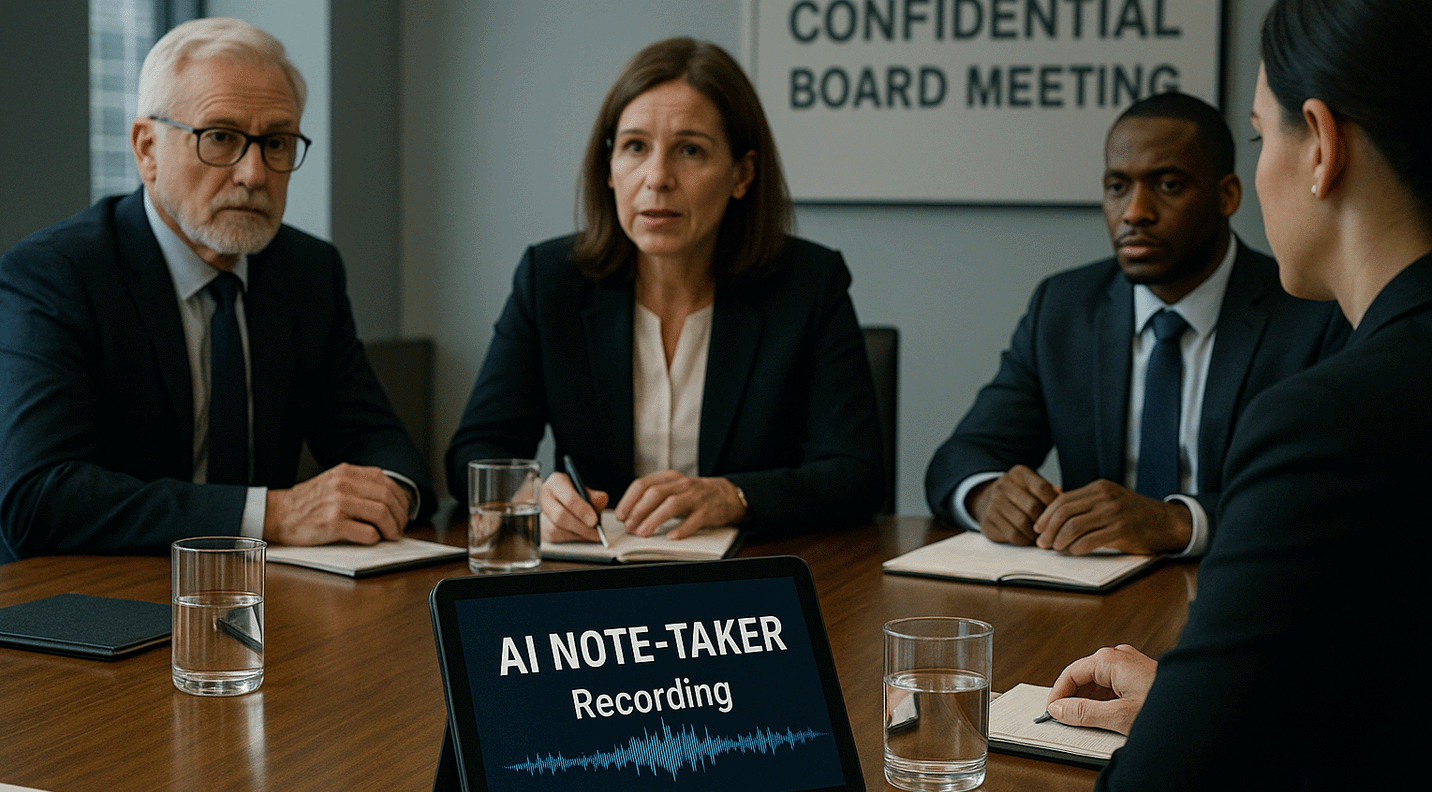
When a third-party AI note-taker joins a meeting, it is not “just a tool”, it is effectively an additional meeting participant that is:
- Recording everything that is being said
- Processing personal and sometimes sensitive data
- Storing transcripts and summaries on a server somewhere you may not control
- May be transferring data outside the UK or EU
In many cases, the meeting host may have no visibility over:
- Where the transcript is stored
- Who can access it
- How long it is kept
- Whether it is used to train AI models
That creates a genuine governance and data-protection risk.
A useful way to think about it is this:
If you wouldn’t allow someone you don’t know to sit silently in your meeting and take notes, you shouldn’t automatically allow an unknown AI to do it either.
This is not about banning AI note-takers
It’s important to be clear: I am not suggesting your organisation shouldn’t use AI note-taking tools.
Many organisations do formally approve AI note-taker tools, but only after:
- Reviewing their security controls
- Understanding data residency (i.e. where the transcripts are being stored)
- Putting contracts and DPAs in place
- Training staff on appropriate use
- Ensuring their staff are signing in using a business account
Where this has been done, AI note-takers can be extremely effective.
The issue arises when:
- Tools are used informally or with a personal account (because anyone can very easily get their own AI note-taker and start using it without it being formally approved by the organisation)
- Approval is ‘assumed’ rather than granted
- External attendees introduce AI tools without discussion/permission.
That is where the risk creeps in.
Best-practice default position for UK organisations
For most UK organisations (particularly professional services firms) a sensible default position is:
Only third-party AI note-takers that have been formally approved for organisation-wide use should be permitted in meetings.
This is not anti-AI.It is pro-governance.
Crucially, organisations must ensure their people are aware of this expectation and understand when AI note-takers can and cannot be used.
Where an organisation has reviewed and approved the use of a specific AI note-taking tool, staff should be required to use it only via a company-managed business account, rather than a personal login. This helps ensure that:
- data is processed under the organisation’s contractual terms
- security, access controls, and retention policies apply
- usage can be monitored and governed
- transcripts and recordings are not tied to an individual’s personal account
Why Microsoft Teams’ built-in transcription is the safest baseline
If your organisation already uses Microsoft Teams, the lowest-risk option for meeting transcription is to use Teams’ native features, such as:
- Meeting recording
- Live transcription
- Facilitator mode for note-taking
The advantages of using the features already built-in to Microsoft Teams are significant:
- Data remains inside your Microsoft 365 tenant
- Storage is in SharePoint or OneDrive under your control
- Retention and deletion follow your policies
- Access permissions are clear
- UK/EU data protections apply
This makes Teams the default “safe choice”, particularly where client confidentiality matters, without the need for third-party AI tools.
What if a client or external attendee brings an AI note-taker?
This is a scenario many organisations feel uncomfortable handling, but clarity helps.
If your organisation is hosting the meeting, you are responsible for what happens in it.
A calm, professional response might be:
“For data-protection reasons, we don’t allow third-party AI note-takers in our meetings. We’re happy to record and transcribe the meeting in Teams and share the notes afterwards.”
This approach:
- Protects your organisation
- Avoids singling anyone out
- Still meets the need for accurate notes
- Signals professionalism, not mistrust
Importantly, removing an unauthorised AI note-taker is entirely reasonable when you are the meeting host. After all – anything that is discussed will be stored on servers you have no control over, so this is something well worth considering.
Should organisations document this?
Absolutely! We recommend organisations:
- Define approved AI tools clearly
- Set expectations for meetings they host
- Explain how transcription will be handled
- Include this in AI or information-security policies
Clear policy removes awkward conversations later.
A sensible, balanced takeaway
AI note-takers are not the problem. Uncontrolled AI note-takers are.
A governance-led approach allows organisations to:
- Embrace AI confidently
- Protect client and staff data
- Avoid accidental compliance issues
- Maintain trust and professionalism
Or, put simply: Use AI, but make sure it’s your AI, on your terms.
Ready to Take Control of AI in Your Organisation?
If AI note-takers are already popping up in your meetings, it’s a sign that AI adoption is happening, whether formally managed or not.
The question is no longer whether your people are using AI. The real question is whether your organisation has the controls, guardrails and governance in place to control how AI is being used, and what data is being shared with it.
At South West AI Solutions, we help organisations:
• Develop structured AI governance frameworks aligned with ISO/IEC 42001
• Define clear AI usage policies and guardrails
• Identify and manage AI-related risks, including Shadow AI
• Train teams to use AI safely, confidently, and productively
• Embed AI into strategy in a way that delivers measurable ROI
AI should feel empowering, not uncertain.
If you would like support reviewing your current AI exposure, defining your governance approach, or training your people to use AI responsibly, book a FREE AI Introductory Session to discuss how we can help you move from reactive to strategic AI adoption.

Matt Greaves
CEO, South West AI Solutions
Matt Greaves is a strategic advisor in the field of AI adoption and governance. With a 25-year career spanning senior leadership, project delivery, and cross-functional communication, he brings a uniquely structured and pragmatic approach to artificial intelligence adoption.
Through South West AI Solutions, Matt and his team support organisations in developing AI governance frameworks, AI strategies, onboarding AI across teams, and embedding scalable solutions that deliver lasting impact. As an AI partner, Matt is committed to guiding organisations through their AI journey – from first steps to full integration.